Templates / 4 min read
Free Press Release Template (2026), With an Annotated Example
“I never got the email”: that’s what a press officer heard when she followed up with a journalist who usually covered her. Her press release, sent through a general-purpose emailing tool, had landed in spam. A press release template can help you organize the facts, but it can’t decide what makes them interesting to a particular reader, or how they reach that reader.
Start with the news, the evidence and the angle. The template below gives those elements a clear structure, while leaving you room to write a message that sounds like your company.
The structure in one picture
- Headline: who + what + why it matters. Under ~12 words.
- Subheadline: one extra fact (number, date, place).
- Dateline + lead paragraph: the whole story in 2–3 sentences. Who, what, when, where, why.
- Proof paragraph: 2–3 numbers.
- Quote 1: your spokesperson, saying something a journalist would want to quote.
- Context paragraph: why now, the bigger trend, your data.
- Quote 2 (optional): a customer, partner or investor.
- Practical details: availability, price, dates, links.
- About: 3–4 lines about your company.
- Press contact: name, email, phone number, link to the press kit.
Aim for one page. If it doesn’t fit, the extra belongs in your press kit.
The template (copy and fill in)
FOR IMMEDIATE RELEASE (or: EMBARGOED UNTIL [date, time, time zone])
[Company] [does what] to [solve which problem for whom]
[One extra fact: a number, a date, a place]
[CITY], [Month Day, Year] — [Company], [a 5-word description], today announced [what]. [Why it matters to the reader, in one sentence]. [Key number].
[Proof: 2–3 facts. Growth, customers, results, test numbers. Use figures, not adjectives.]
“[A quote that gives an opinion, a vision or a story — not a feeling],” said [First Last], [title] of [Company]. “[Second sentence that adds a concrete detail].”
[Context: why now? What trend, regulation or behavior change does this news illustrate? Add one original data point if you have it.]
“[Quote from a customer, partner or investor explaining why they’re involved],” said [First Last], [title], [Organization].
[Practical details: availability date, price, where, how to try it, link.]
About [Company]
[Company] [what you do] for [whom]. Founded in [year] by [founders], [the company] [key fact: team size, customers, funding]. [Website]
Press contact
[First Last] · [email] · [phone]
Press kit (photos, logos, bios): [link]
A fictional example, with notes
Nuvo cuts restaurant food waste by 30% with an AI ordering assistant, raises €4M
Already used by 1,200 restaurants in France and Belgium
PARIS, October 14, 2026 — Nuvo, a Paris-based food-tech startup, today announced a €4M seed round led by [Fund] to roll out its AI ordering assistant to independent restaurants across Europe. Restaurants using Nuvo throw away 30% less food on average in their first three months.
📝 Note: the headline gives the result (30% less waste) before the money. The amount is news for investors; the result is news for readers.
Since its launch in 2025, Nuvo has grown to 1,200 restaurants and processes 40,000 supplier orders a month. Revenue grew 5x over the last 12 months.
📝 Three numbers, zero adjectives. A journalist can reuse every one of them.
“Independent restaurants order with a notebook and their gut feeling. That’s how a kitchen ends up throwing out 20 kilos of fish on a Monday,” said Léa Martin, CEO of Nuvo. “We give them the forecasting tools that big chains have had for years.”
📝 The quote tells a story (20 kilos of fish on a Monday). Compare it with: “We’re thrilled to support restaurants in their journey.”
[Context paragraph, second quote, about section, press contact…]
10-point checklist before you hit send
- Can a stranger understand the headline in 5 seconds?
- Is the full story in the first paragraph?
- At least 2 numbers a journalist can reuse?
- Do the quotes say something nobody else could say?
- No jargon (“leveraging synergies”, “disruptive solution”)?
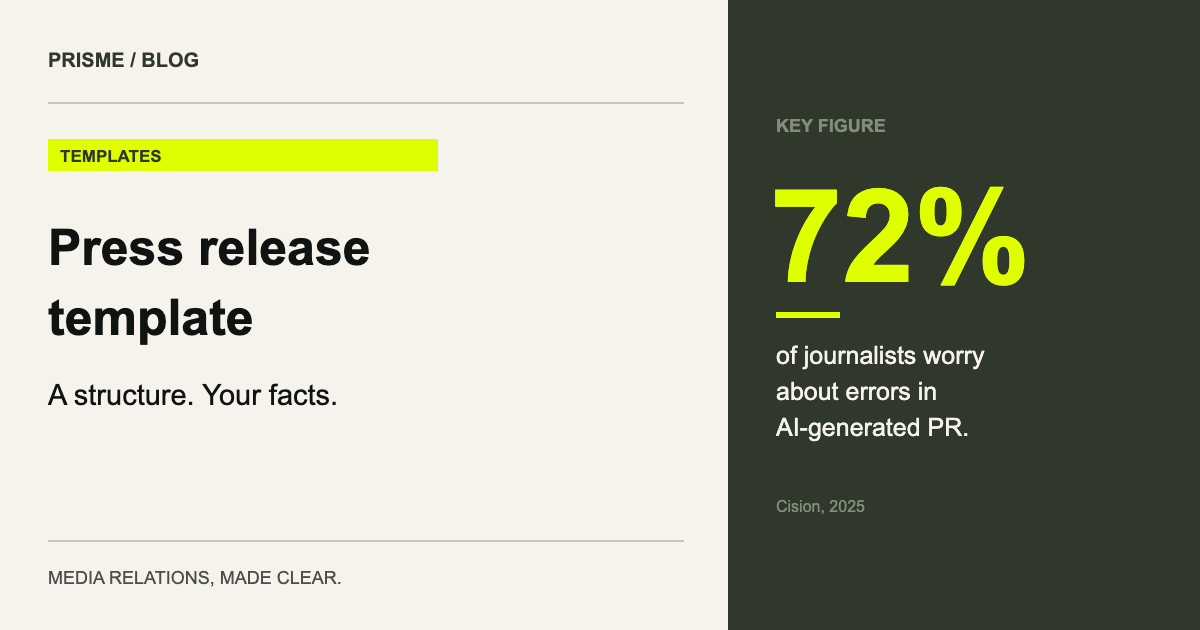
- Is every fact checked? 72% of journalists worry about factual errors in AI-generated PR content (Cision 2025). If you used AI to draft it, check every number and name yourself.
- High-res photos available via a link, not attachments?
- A real phone number in the press contact?
- Embargo agreed with each journalist before sending (if you use one)?
- Sent individually to journalists who cover this topic, with a personal first line, not as a mass BCC?
The release is 50% of the job
The best press release still fails if it goes to the wrong people. 86% of journalists say they reject a pitch that isn’t aligned with their beat or audience (Cision 2025).
Write your release, then spend at least as long choosing who gets it.
Doing it with PRisme
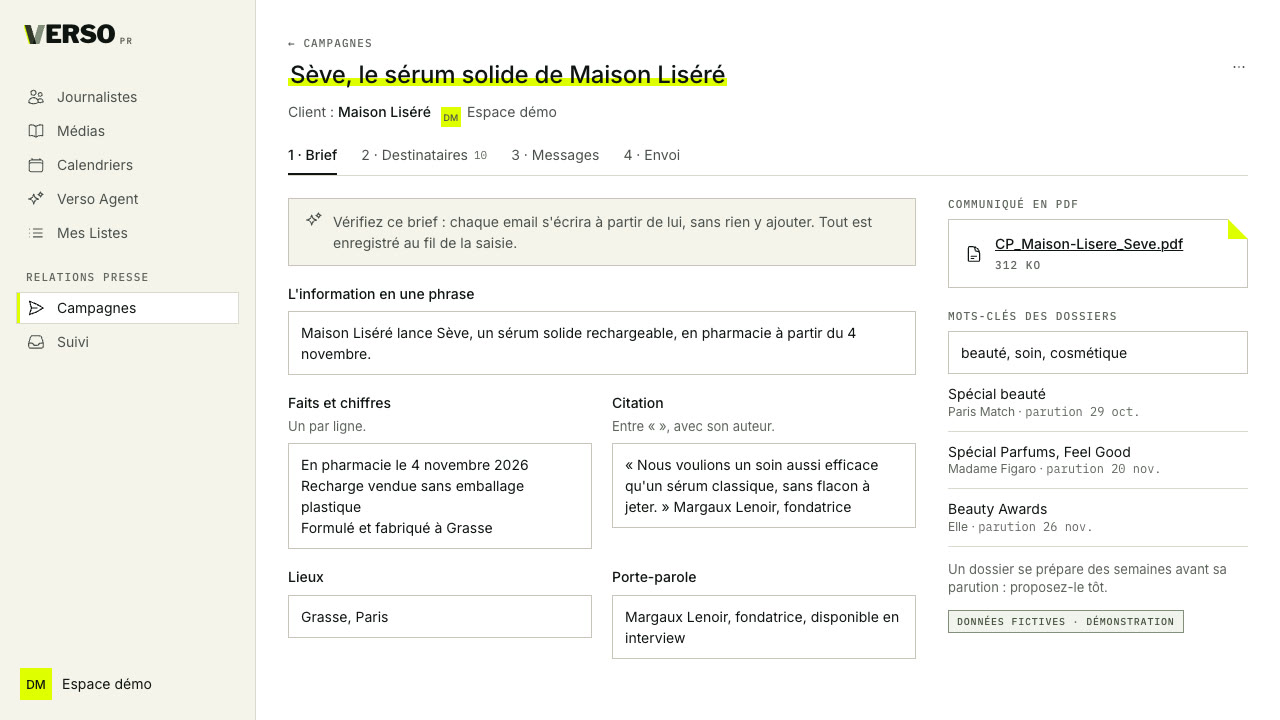
With PRisme, your press release no longer lives in a separate document: PRisme’s AI generates it in your own tone and format, key figures included, in the editor built into your campaign (headline, quotes, images, video, attachments, “About” block), it goes out with every personalized pitch, and its text is used to find the journalists who cover the topic among 30,000+ verified press contacts. Then you track who was pitched, followed up and replied. To stay out of spam folders, sending follows anti-spam rules: each email goes out one at a time from your own mailbox, at a capped pace and daily volume, with an unsubscribe link checked before every send. Book a demo.
FAQ
How long should a press release be?
One page, roughly 300–500 words. Put the details in a press kit.
What’s the difference between a press release and a pitch?
The press release is the official document with all the facts. The pitch is the short personal email that tells one journalist why this matters to them, with the release linked or pasted below.
Should I paste the press release in the email or attach it?
Paste the key parts in the email body and link to the full version and photos. Attachments often end up in spam.
Can I use AI to write a press release?
Yes. PRisme, for example, generates the complete press release in your team’s tone and format, key figures included, directly in your campaign’s editor. You read it, approve it, and it goes out with your pitches.
Sources
- Cision — 2025 State of the Media Report (3,000+ journalists, 19 markets, May 2025)