Guides / 7 min read
How to Announce Your Funding Round to the Press: A 6-Week Plan
An investor who helps young companies grow put it bluntly: there’s nothing built for a startup that wants to announce its funding round without an agency. Before you look for journalists, one question matters more than any other: what do you want the funding to say about your business?
The amount, the market problem and the next stage of growth can lead to different stories and different journalists. This guide helps you choose those angles before you start sending emails.
Step 0: Does your round pass the “so what?” test?
A journalist will ask one question: why should my readers care? The amount alone is not an answer. Before anything else, write down your answer to these:
- What changes now? New market, new product, hiring 40 people in Lyon, opening the US…
- What proof do you have? Revenue growth, number of customers, a known client. Numbers you’re willing to publish.
- What’s the bigger trend? Your round as evidence of something larger (a sector shift, a regulation, a behavior change).
- Who can speak? A founder and a customer or investor who can say something more interesting than “we’re thrilled”.
That’s not just intuition. When asked what they value most in a pitch, journalists cite relevance to their beat (70%), access to interview sources (58%), original data (40%) and high-resolution images (37%) (Muck Rack, State of Journalism 2026).
💡 Tip: if you have a dataset nobody else has (from your product, your customers, your market), turn one insight into a chart. A round + an original data point is a much stronger story than a round alone.
Exclusive or embargo? Choose before you pitch
This is the most important decision, and most founders get it wrong by trying to do both.
| Exclusive | Embargo | |
|---|---|---|
| What it is | One media outlet gets the story first, alone. | Several journalists get the news in advance, and all publish at the same agreed time. |
| Best for | A strong story you want in one top-tier outlet. | Broad coverage across trade, regional and tech media. |
| Risk | If they say no, you lose a few days. | Someone breaks it early; journalists dislike “everyone publishes at 7am” stories. |
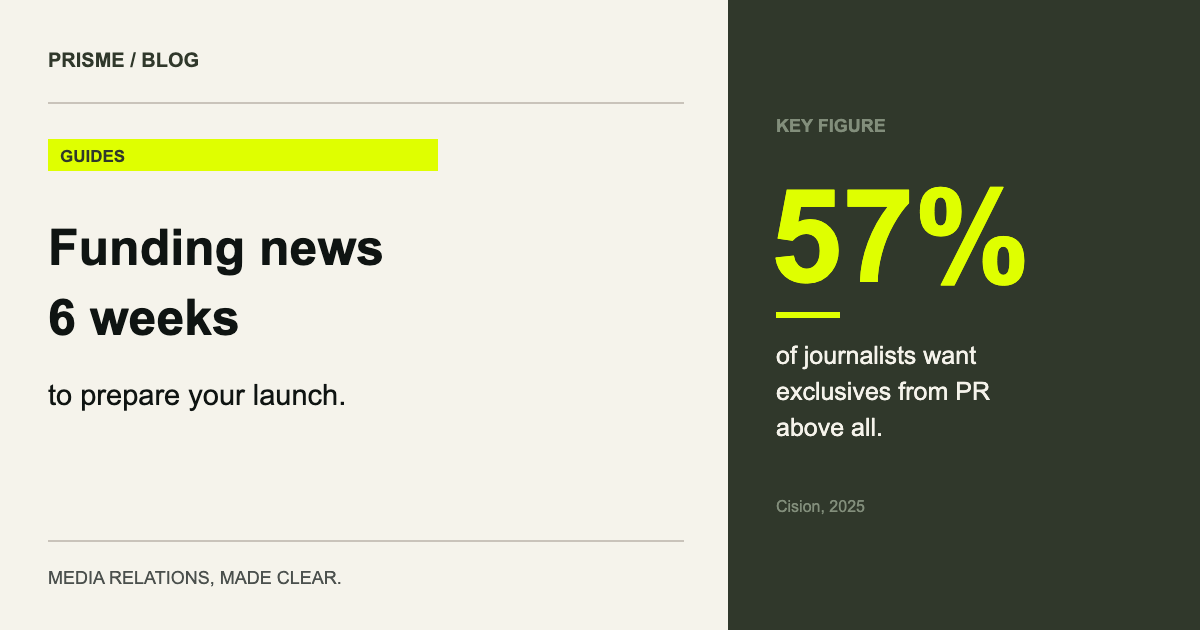
The data leans toward exclusives: 57% of journalists say an exclusive is what they want most from PR professionals (Cision, 2025).
Our recommended setup for most startups: one exclusive with your #1 target, then an embargoed send to everyone else a few hours after that exclusive goes live.
⚠️ An embargo is only valid if the journalist agrees to it before you send the information. Writing “EMBARGO” in an email subject isn’t a contract. As one business editor put it, unilateral embargoes aren’t binding (Talking Biz News). Ask first: “Can I share news under embargo until Tuesday 7am?”, and send the details only after a yes.
The 6-week timeline
T-6 weeks: lock the basics
- Agree internally (and with investors!) on the announcement date, the amount you’ll disclose, and the lead investor’s name. Investors often want to approve the press release.
- Choose 1 founder spokesperson. Prepare them with 5 key messages.
- Book a photographer: a recent, high-resolution team photo (horizontal and vertical) is worth more than you think.
T-4 weeks: build your media list in 3 tiers
- Tier 1 (1–3 names): your exclusive targets. Journalists who have covered your sector in the last 3 months. Read their last 5 articles.
- Tier 2 (10–30 names): trade media for your industry (your customers read them), tech/startup media and their weekly funding roundups.
- Tier 3: regional press (if you’re hiring locally), your investors’ newsletters, podcasts in your niche.
Never pitch a journalist who hasn’t written about your topic recently. 88% of journalists immediately delete pitches that miss their beat (Muck Rack 2026).
T-3 weeks: write the press release and the press kit
Your press release in this order:
- Headline: who + amount + why it matters (“Startup X raises €5M to bring [what] to [whom]”).
- First paragraph: the full story in 3 lines: amount, investors, what the money is for.
- Proof: 2–3 numbers (growth, customers, team size).
- The trend: why now, in one paragraph.
- Two quotes that say something: from the founder (vision) and the investor (why they bet). Ban “we’re thrilled”.
- About section + contact (with a phone number).
Then a simple press kit link (not an attachment): press release, photos, logos, founder bios, a product screenshot.
💡 With PRisme, you don’t write it from scratch: give a few lines about your round (amount, lead investor, use of funds, key numbers) and PRisme’s AI generates the complete press release, figures included, directly in your campaign’s editor, in this exact structure.
T-2 weeks: pitch your exclusive
A short, personal email to your Tier 1 journalist. Example:
Subject: Exclusive offer: [Startup] raises €5M to [do what], under embargo
Hi [first name],
I read your piece on [specific recent article] — [one sentence on why it’s relevant].
We’re announcing on [date] that [Startup] has raised €5M led by [Investor] to [do what]. Since you’ve covered [topic], I’d like to offer you the exclusive. We can share [numbers / data / customer interview].
Would you be interested? If yes, I’ll send the full details under embargo.
[Name, phone]
No answer after 2–3 working days? Follow up once (that’s what 62% of journalists recommend, according to Cision), then move on to your #2.
T-1 week: embargoed pitches to Tier 2
- 1:1 emails, never a giant BCC list. Personalize the first line.
- Send in the morning, between 9 and 11am local time, ideally Monday–Tuesday, when journalists plan their week.
- Prepare your LinkedIn posts (founder + company + investors). LinkedIn is now the platform journalists trust the most (58%, Muck Rack 2026), and many follow startups there directly.
D-Day
- Exclusive goes live → embargo lifts → press release on your website newsroom.
- Founder, team and investors post on LinkedIn in the same hour.
- Email your customers and partners: they’re the people who matter most.
- Answer journalists fast. Keep your spokesperson’s calendar free.
T+1 to T+2 weeks: turn coverage into long-term value
- Add the articles to your website (“As seen in…”) and sales decks.
- Pitch a second angle to journalists who didn’t cover it: your data, a customer story, a founder op-ed.
- Track who opened, who replied and who said “not now”, so you don’t start from zero next time.
Why this matters more in 2026: AI is reading the press
When a future customer, recruit or investor asks ChatGPT “who are the best startups in [your sector]?”, the answer comes mostly from press coverage. Muck Rack analyzed more than 25 million links cited by ChatGPT, Claude and Gemini: 84% came from earned media, and journalism alone represented 27% (What Is AI Reading?, May 2026).
Your funding announcement is one of the rare moments where journalists actually want to write about you. Use it well and it keeps paying off long after the news cycle.
7 mistakes that kill funding coverage
- Announcing on a Friday afternoon or in mid-August.
- Sending the full press release to 200 journalists in BCC.
- A unilateral “embargo” nobody agreed to.
- No numbers except the amount.
- Attachments instead of a link (spam filters love those).
- Quotes that say nothing (“we’re thrilled to partner with…”).
- No follow-up plan: the round is announced, then silence for 6 months.
Doing it with PRisme
With PRisme, the whole announcement fits in one campaign: drop in your press release to get the journalists who cover your topic (finance, your sector, your region in one search), see who on your team already knows them, spot anyone already being pitched for another client, let PRisme’s AI generate your complete press release (headline, lead, key figures, quotes, About block), generate a personalized pitch for each journalist and track the replies. Book a demo.
FAQ
When should I announce my funding round?
Ideally 2–6 weeks after the money is in the bank and documents are signed, never before. Avoid Fridays, holidays and big tech events where your news will drown.
Should I disclose the amount?
Yes, if you can. Journalists rarely cover a round with an undisclosed amount unless the story is very strong. If you can’t, give other proof (growth, customers).
Exclusive or embargo for a seed round?
For most seed rounds: one exclusive with a sector-specific or startup media outlet, then an embargoed send to trade and regional media.
Do I need a PR agency to announce a round?
Not necessarily. With a clear story, a well-targeted list and 6 weeks, a founder can do it. An agency helps when you lack time or relationships.
Sources
- EY Venture Capital Barometer, H1 2026 (published July 8, 2026), via France Épargne
- Muck Rack — State of Journalism 2026, 897 journalists, Jan–Mar 2026
- Cision — The best time to send a PR pitch (2025 State of the Media data, 3,000+ journalists)
- Talking Biz News — Do reporters prefer an exclusive or embargo?
- Muck Rack — What Is AI Reading?, May 2026 (summary)