Guides / 5 min read
How to Pitch Journalists: 4 Email Templates That Get Replies
Should follow-ups be automated? A consultant at a large communications agency first told us yes, then conceded that it’s precisely the part that needs the most nuance: the same pitch doesn’t work for everyone, and the phone is still a favourite tool. Between generic emails sent to hundreds of journalists and hours of writing by hand, there’s little time left to think about the story.
For me, a useful pitch starts with context: the journalist’s recent work, previous exchanges and their connection to the campaign’s angle. This guide shows how to turn that context into an email worth reading.
Why pitches get deleted
Muck Rack asked 1,515 journalists why they delete pitches (State of Journalism 2025):
| Reason | % of journalists |
|---|---|
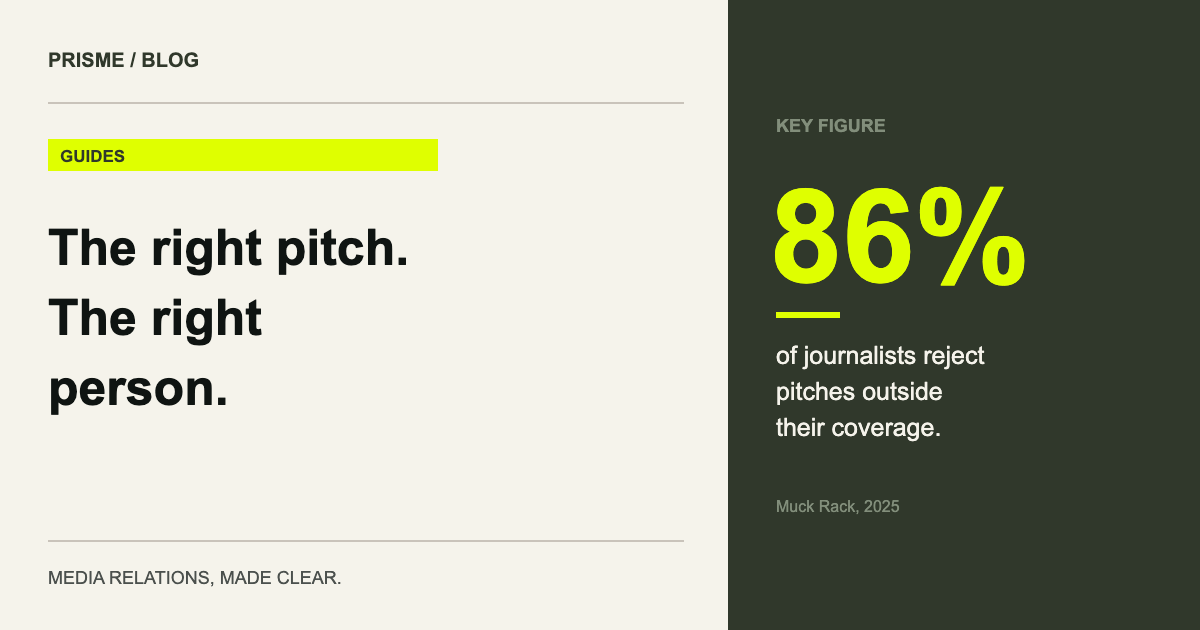
| Not relevant to my beat | 86% |
| Too promotional | 71% |
| Obviously a mass email | 50% |
| Repeated sends without a reply | 44% |
| Too long or unclear | 43% |
| Wrong name or outlet | 33% |
| No access to a source | 26% |

In 2026, the number is even higher: 88% delete pitches that miss their beat without reading further.
Notice what’s not on the list: bad grammar, the wrong day, the wrong font. The #1 problem is sending to the wrong person. Your pitch fails before the first word if the journalist doesn’t cover your topic.
What journalists want in a pitch
From the 2026 survey, what journalists value most (Muck Rack 2026):
- Clear relevance to their beat: 70%
- Access to sources for interviews: 58%
- Original data or research: 40%
- High-resolution images: 37%
And from Cision: 57% of journalists say exclusives are what they want most from PR people (Cision, 2025).
The anatomy of a good pitch
- Subject line: the story, not “Press release” or “Partnership opportunity”. Be specific.
- Line 1: why them. Reference a recent article they wrote, precisely.
- Lines 2–3: the story. What’s new, why it matters to their readers, one key number.
- Line 4: what you offer. An interview, data, an exclusive, photos.
- A simple question. “Would this be useful for you?”
- Your name and phone number. Then the press release pasted below your signature, or linked.
Total: under 150 words before the press release. If it doesn’t fit on a phone screen, it’s too long.
Before / after
❌ Before
Subject: Press release – Nuvo
Dear journalist,
We are thrilled to announce that Nuvo, the leading innovative AI-powered platform for the restaurant industry, has closed a funding round. Please find attached our press release. We would be delighted if you could feature us in your publication.
Best regards
✅ After
Subject: Restaurants waste 30% less food with this AI tool, data from 1,200 kitchens
Hi Sarah,
Your piece last week on rising food costs for independent restaurants stuck with me, especially the chef throwing away €400 of fish a week.
We’ve just measured something related: across 1,200 restaurants using Nuvo, food waste dropped by 30% in three months. We’re announcing a €4M round on Tuesday, but the data is the more interesting part.
I can share the full dataset and connect you with two restaurant owners in Lyon. Would that be useful?
[Name] · [phone]
(Nuvo is a fictional example.)
4 templates to adapt
Template 1: News (launch, funding, partnership)
Subject: [Result or change] — [Company] [news], [date]
Hi [first name],
I read your article on [specific recent article]. [One sentence on the link.]
On [date], [Company] is announcing [news]. Why it matters for your readers: [one sentence]. [Key number].
I can offer you [exclusive / interview with X / data / photos]. Would you be interested?
[Name, phone]
Template 2: Data / study
Subject: New data: [surprising finding in 8 words]
Hi [first name],
Since you cover [topic], I thought this might be useful: we analyzed [what, how many] and found that [key finding]. [Second finding.]
The full methodology and data are available, and [expert] can comment. Happy to share it with you first.
[Name, phone]
Template 3: Expert comment on the news
Subject: Comment on [today’s news] — [expert name], [title]
Hi [first name],
Regarding [today’s news], [Expert], [title at Company], has a different take: [one-sentence opinion].
[One fact or experience that supports it.]
Available today for a call or a written quote.
[Name, phone]
Speed matters here: send it within hours of the news, not days.
Template 4: Introduction (no story yet)
Subject: Hello from [Company] — a source on [topic]
Hi [first name],
I follow your coverage of [topic], especially [article]. I handle press for [Company], which [what you do in one line].
No pitch today. I just wanted to say that if you ever need [data / an expert / a field example] on [topic], I’m happy to help.
[Name, phone]
Don’t underestimate this one: 85% of journalists say the best way to build a relationship is to introduce yourself by email, even without a story (Cision State of the Media 2025).
Follow-ups: once, and add something
62% of journalists recommend following up only once (Cision). Wait 2–3 working days, and add something new: a number, a photo, a new angle. Never just “did you see my email?”.
Follow-ups are also the hardest part to automate. A consultant at a large Paris agency told us that if she could automate one thing, it would be follow-ups, “but that’s the whole challenge: it’s not possible, because it needs too much subtlety and human contact. One pitch doesn’t work for every contact, and the phone is still one of our favorite tools.”
That’s also our view: AI can prepare the draft, but a human should decide who to follow up with, how, and when to pick up the phone.
Timing
- Send in the morning, ideally 9–11am in the journalist’s time zone.
- Monday and Tuesday mornings work well: journalists plan their week (Cision).
- For monthly magazines, think in months: their deadlines are far ahead. Christmas stories are pitched in October, sometimes earlier.
Doing it with PRisme
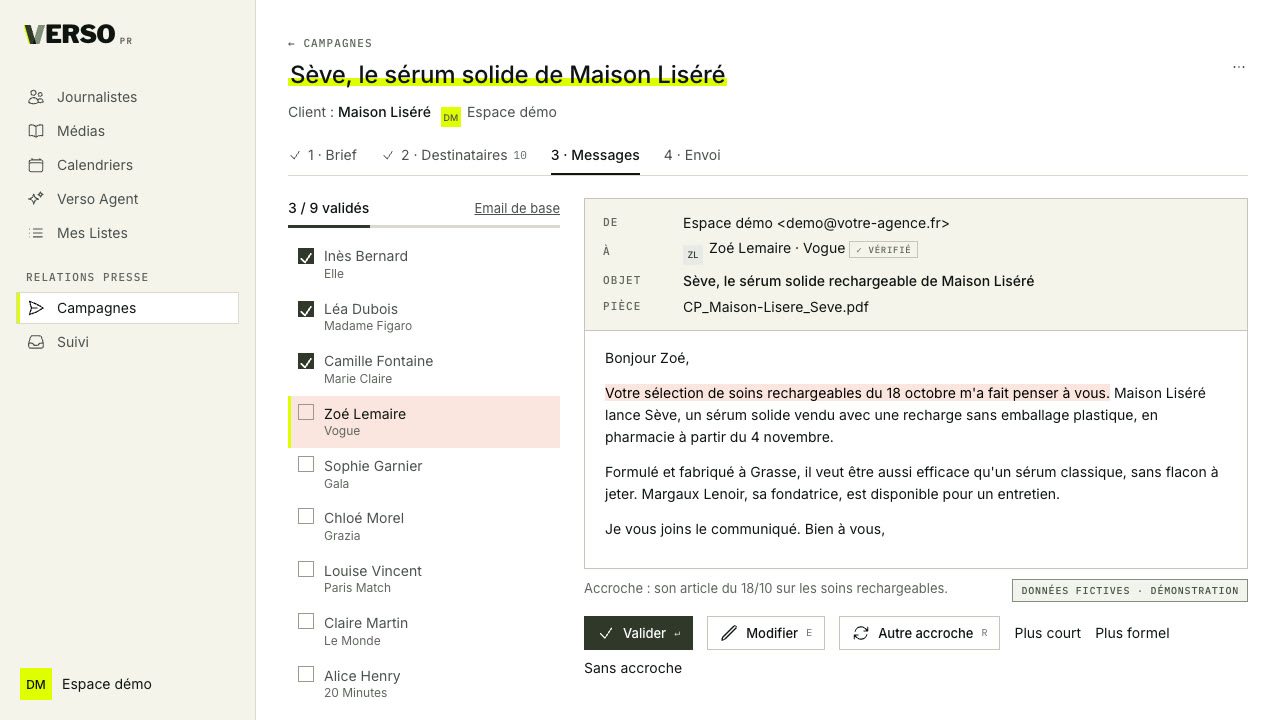
With PRisme, each journalist in your campaign gets a pitch draft with an opener tuned to your relationship and a hook from their most relevant recent article, with your press release attached. You edit every word, then track who was pitched, followed up, replied or declined. Nothing goes out without you, and sending follows anti-spam rules: one email at a time from your own mailbox, a capped pace and daily volume, unsubscribes checked before every send. Book a demo.
FAQ
How long should a pitch be?
Under 150 words before the press release. Short enough to read on a phone.
Should I call journalists?
In France especially, yes, once you have a relevant story, and ideally after an email. Ask if it’s a good time, and be brief.
Can I use AI to write pitches?
For a first draft, yes. But personalize the first line yourself and check every fact. 72% of journalists worry about factual errors in AI-generated PR content (Cision 2025).
Sources
- Muck Rack — State of Journalism 2026 · State of Journalism 2025 (original report)
- Cision — State of the Media 2025 · The best time to send a PR pitch
- PRisme — interviews with French PR agencies, 2025–2026