Guides / 4 min read
How to Build a Media List That Actually Works (+ Free Template)
In our October 2026 survey of PR professionals, building media lists comes top of the time sinks, named by 7 respondents out of 12. The PR lead of a Paris exhibition venue estimates that finding contacts took 60 to 75% of her time: every exhibition has a new theme and sends her looking for a new corner of the press.
Building a targeted media list means making those choices explicit: why this journalist, why this angle and what your team already knows about the relationship. That’s what makes the difference: 88% of journalists delete pitches that miss their beat (Muck Rack, 2026). Here’s a method for doing that.
Step 1: Start from the story, not the category
Don’t start with “tech journalists” or “lifestyle media”. Start with one sentence: what’s the story, and who would care?
- “A Lyon startup cuts restaurant food waste by 30%” → food & restaurant trade press, Lyon regional media, sustainability journalists, foodtech newsletters.
Each story deserves its own list. Your “master list” is just a pool you pick from.
Step 2: Find journalists who wrote about it recently
A beat on a profile is a hint. What they published in the last 3 months is proof.
- Search Google News for your topic and the last 3 months.
- Read the bylines. Click through to the author pages.
- Note the article that makes them relevant: you’ll reuse it in your pitch’s first line.
Step 3: Organize in 3 circles
| Circle | Who | How many | How you pitch |
|---|---|---|---|
| 1. Priority | Journalists who covered your exact topic recently, in outlets your buyers read | 3–10 | Fully personalized, exclusive offers, phone |
| 2. Relevant | Trade media, beat journalists, newsletters, podcasts | 10–40 | Personalized first line |
| 3. Wider | Regional press, roundups, partners’ channels | As needed | Shorter, still 1:1 |
Step 4: Don’t forget the formats people forget
- Podcasts. Agencies told us they’re largely missing from some big databases, while one French vendor indexes nearly 10,000 French podcasts. Niche shows are often easier to get on, and their audience listens to the end.
- TV and radio by show, not by channel. “France Inter” is not a contact. A specific show and its producer are.
- Newsletters and independent journalists, many of whom now publish on their own.
- The media AI assistants cite in your sector. They’re now a priority (see our guide on [getting cited by ChatGPT]).
Step 5: Use the right columns
| Column | Why |
|---|---|
| First name, last name | Obvious, but check the spelling |
| Outlet + section/show | A section is more useful than an outlet |
| Professional email, phone (if public) | Phone is still a key channel in France |
| Relevant recent article (link + date) | Proof of relevance + your first line |
| Circle (1, 2, 3) | Who gets what level of effort |
| Deadline / editorial calendar | Monthlies close weeks ahead |
| Last contact (date, topic, client) | Avoid pitching twice in a week |
| Result (covered, declined, no reply) | Your memory for next time |
| Notes & preferences | “Prefers phone”, “no embargoes”… |
| Do not contact (global / per client) | See step 7 |
Step 6: Use editorial calendars
Agencies told us editorial calendars are one of the most useful, and most underused, tools. They list each outlet’s special issues and their closing dates. A December gift guide closes in October, sometimes earlier. If you pitch in December, you’re two months late.
Step 7: Give your list a memory
This was the biggest gap in every agency interview: no memory of who said no. A consultant leaves, and the knowledge leaves with her. A journalist asks to stop receiving emails for one client, and nobody knows if that applies to the others.
Three simple rules:
- Log every result: covered, declined, wrong person, prefers another format.
- Keep exclusions visible. One French vendor we spoke with keeps excluded contacts in a visible “excluded” bucket instead of deleting them, so a refreshed search doesn’t bring them back. Copy that idea, even in a spreadsheet.
- Separate global and per-client opt-outs. A journalist can say no to Client A and still want to hear from Client B.
Keep it fresh
- Before each campaign, re-check circle 1: still at the same outlet? Still on the beat?
- Every quarter, clean the bounces and the people who never open.
- When you pitch a new country, don’t just buy a list. An agency founder told us country lists cost “several hundred euros for a cold list” with no context on the outlets, and need re-buying after about six months.
Doing it with PRisme
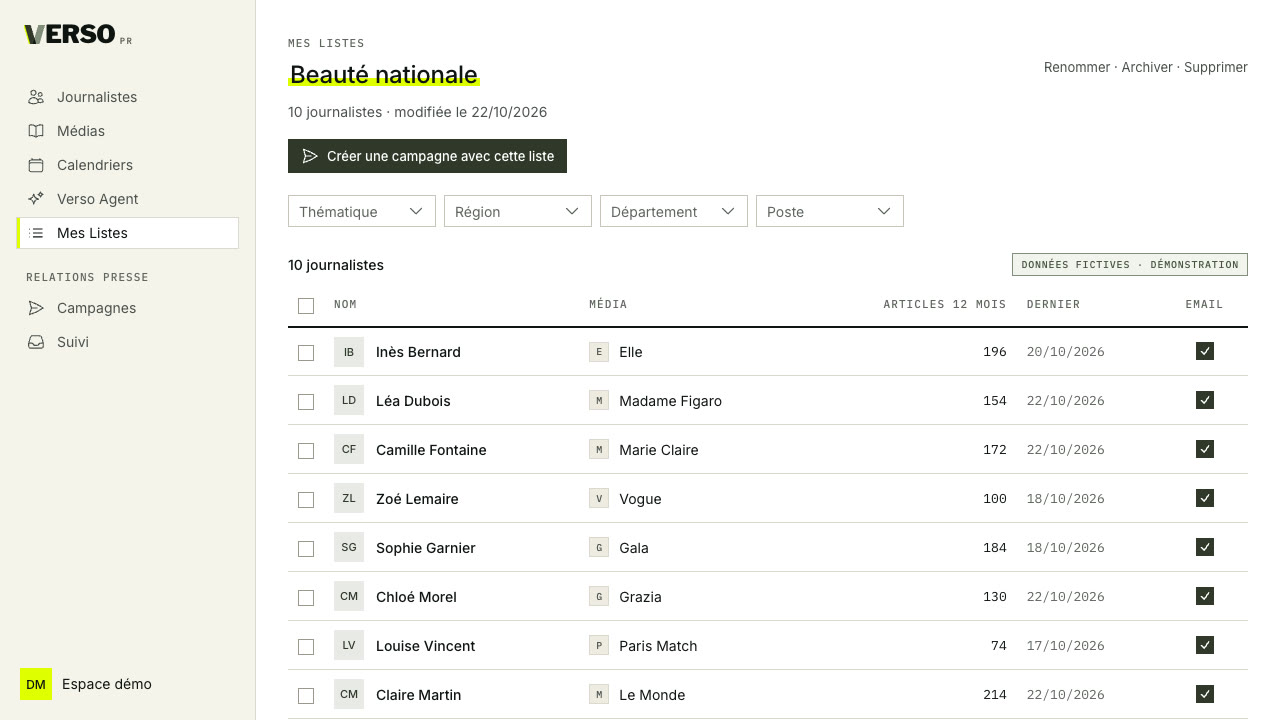
With PRisme, describe your story, even across several angles at once, and get a ranked list from 30,000+ verified French press contacts, with the reason for each match and their latest articles. Save it for your campaign, see who on the team already knows each journalist, and keep every exchange in a shared CRM. Book a demo.
FAQ
How many journalists should be on a media list?
For one story: often 15–50 well-chosen names beat 500 random ones. Circle 1 rarely exceeds 10.
Can I buy a media list?
You can, but bought lists are usually generic and age fast. Use them as a starting point, then qualify every name.
How often should I update my media list?
Check your priority journalists before each campaign and clean the whole list at least every quarter.
Sources
- Muck Rack — State of Journalism 2026
- Cision — State of the Media 2025 (summary)
- PRisme — interviews with French PR agencies and one vendor demo, 2025–2026