Trends / 7 min read
PR in 2026: What Practitioners Told Us
Between late September and late October 2026, we spent time with the people who do media relations every day: agency consultants (from 2 to 50+ people), in-house communications leads at companies and cultural institutions, and a freelance film publicist. Six in-depth interviews, plus twelve answers to an online questionnaire.
The sample is small and we don’t give it any statistical weight. But the same frictions came up from one conversation to the next with striking regularity. Here’s what we heard. Download the survey (PDF in French, 23 October version with the first 10 answers).
Key figures
| Figure | What it measures |
|---|---|
| 3.2 / 5 | average satisfaction with their journalist database tool |
| 7 out of 12 | name building media lists as a major time sink |
| 8 out of 12 | complain about journalists missing from their database |
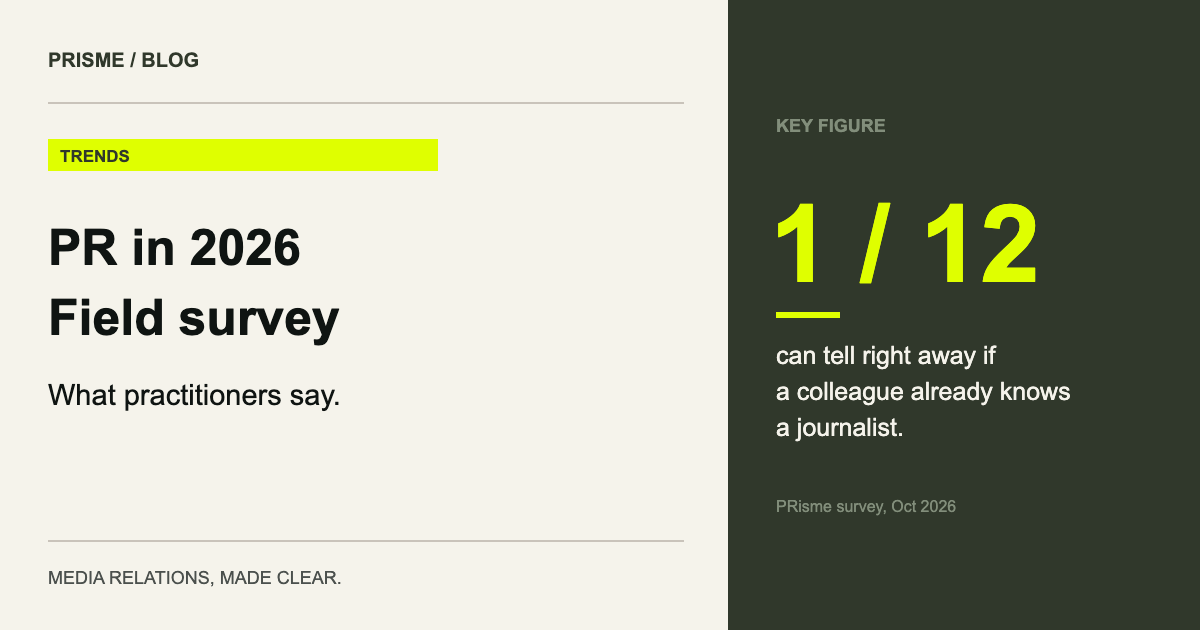
| 1 out of 12 | can tell right away whether a colleague already knows a journalist |
| 3.9 / 5 | for automatic reporting, the most wanted feature |
| 2.9 / 5 | for an “all-in-one” AI agent driven by a single prompt |
1. Finding the right journalist is still the core problem
It’s the most consistent complaint, whatever the size of the team or the tool used. The PR lead of a Paris exhibition venue estimates that finding contacts took 60 to 75% of her time. Her word for it: “sluggish”. Every exhibition has a new theme (LGBTQ photography, Latin America, literature…) and sends her looking for a new corner of the press.
Existing databases don’t help much. At a five-person agency, the team described checkbox filters, a poorly kept taxonomy (defence filed under politics), and empty categories even though the journalists exist. A consultant at a large group sums it up: listed specialties are often too broad, too vague or incomplete. What still works best, she says, is what the team knows.
In the questionnaire, building lists comes top of the time sinks (7 answers out of 12), ahead of finding journalists itself (5) and finding contact details (5). To search, respondents combine tools: Cision or Data Press (9 out of 12), LinkedIn (8), Excel files (7), and already a general-purpose AI for three of them. Asked what they would improve first if they could change only one thing, five mention search or lists: “building press lists”, “finding journalists who match the subject”.
“Finding contacts is 60 to 75% of a PR person’s time.” PR lead, Paris exhibition venue
2. Data ages faster than the tools
The second pain point is freshness. The three most cited answers are about data quality, not usability:
| What gets in the way of finding journalists | Respondents out of 12 |
|---|---|
| Missing journalists | 8 |
| Missing contact details | 8 |
| Outdated contacts | 7 |
| Truly relevant journalists can’t be found | 4 |
| Unintuitive interface | 3 |
| International data | 3 |
| Search too rigid | 2 |
One respondent would simply like “emails to update automatically when journalists change newsrooms”. In practice, the workaround is manual: you call the newsroom to get the address of a journalist who just wrote about you. International campaigns make it worse. An agency founded eleven years ago buys “cold” lists country by country for its campaigns in Italy or Poland: a few hundred euros for names without context, out of date after about six months.
3. Relationship memory lives in people’s heads and in Excel
PR sells relationships. Yet only one respondent out of twelve can tell right away whether a colleague already knows a journalist: six answer “with difficulty”, five “yes, after some digging”. History is kept in spreadsheets (8 out of 12), in inboxes (5), in internal notes or in “the consultants’ memory”. One respondent sums up what she wants: “a complete follow-up tool to track, contact, report… a real CRM”.
One agency told us it has no record of the journalists who declined or asked to stop receiving press releases: when a consultant leaves, that knowledge leaves with her. It tried two CRMs built for sales or email marketing, without finding what it needed.
4. Sending: makeshift setups and the spam folder
Ten respondents out of twelve send and follow up from Gmail or Outlook. The alternatives are hardly better integrated: exporting the database to the email host for big sends, with no deliverability measurement, or campaigns through a general-purpose emailing tool that land in the spam folders of journalists who usually cover them. “I never got the email,” a press officer heard when she followed up.
Should everything be automated, then? Practitioners are nuanced. A consultant at a large agency would like to automate follow-ups, before conceding that it’s precisely the part that needs the most nuance. The need isn’t to send more, but to know what was sent, received, and by whom.
5. Monitoring and reporting: where the demand for automation is strongest
That’s the survey’s paradox: the sharpest pain is upstream (search), but the best-rated features are downstream.
| What they want from a new tool | Average score out of 5 |
|---|---|
| Automatic reporting | 3.9 |
| Attributing coverage to a campaign | 3.8 |
| Media monitoring | 3.7 |
| Journalist recommendations | 3.6 |
| Relationship history | 3.5 |
| AI search from a brief | 3.4 |
| Outreach and follow-ups | 3.4 |
| Autonomous “one prompt” AI agent (8 answers) | 2.9 |
| Who on the team knows whom | 2.8 |
| International search | 2.6 |
Monitoring is split across several providers chosen client by client, separate from the journalist database: the link between a campaign and its coverage is rebuilt by hand, in Excel. The tools work with keywords and surface false positives (a venue called “Le Bal” gets articles about village dances), miss newsletters and podcasts, and charge by volume of coverage: a successful exhibition costs more than budgeted. In the questionnaire, one respondent would most like to sort her coverage “by category, by press release, by tone”.
6. Expensive tools for middling satisfaction
Satisfaction with the main tool tops out at 3.2 out of 5, and only one respondent says they are fully satisfied. Prices aren’t middling: around €4,000 a year excl. VAT for an agency license, around €10,000 for a larger agency, plus monitoring packages per client.
That price level effectively shuts out the smallest teams. A two-person film PR agency works with no journalist discovery tool at all, just Excel lists and €15-a-month monitoring. Respondents juggle two to three tools per campaign on average, up to five for some.
7. AI: yes for search, no to autopilot
Practitioners don’t reject AI; they expect precision from it. Personalized journalist recommendations score 3.6 / 5, search from a brief 3.4. But an autonomous agent that writes press releases, picks journalists and sends emails from a single prompt only gets 2.9 / 5, among the lowest scores.
An agency that tried its tool’s natural-language search found it superficial: good targeting relies on a fine knowledge of the press that a search engine can’t guess. AI is expected to speed up judgment, not replace it.
What we take away
- Search should start from the story, not from categories. Knowing who actually wrote about LGBTQ photography or the social economy beats a “Culture” checkbox.
- Fresh data is a feature. Newsroom moves, contact details, international coverage: that’s where trust is won.
- The team’s memory has to survive departures. Who knows whom, who said no, for which client.
- Sending has to be measured. Know what arrived, and where, before following up by hand.
- Campaigns and coverage should speak the same language, so reporting stops being an Excel exercise.
- People stay in charge. The pitch, the follow-up, the phone call: the tool prepares, the professional decides.
That’s the line we follow in building PRisme: an AI that recommends and prepares, and professionals who stay in control of every email.
Methodology. Qualitative interviews conducted between late September and late October 2026 with two Paris agencies, a consultant at a large group, a two-person film PR agency, a PR lead at a cultural institution, and an investor. Online questionnaire: 12 answers (5 to 27 October 2026): in-house communications, PR agencies (one respondent works in both), a freelancer and a former PR professional. Eight work in a team of 2 to 5 people. Non-representative sample; quotes are anonymized.
Want to take part in the next round? Write to us at [email protected].