Trends / 4 min read
How to Get Your Brand Cited by ChatGPT: A PR Guide for 2026
Search is changing. To compare tools, choose a provider or learn about a company, more and more people no longer type their question into Google: they ask ChatGPT, Claude, Gemini or Perplexity directly. And the assistant doesn’t return ten blue links, it gives an answer, with a handful of sources.
For PR teams, this is a turning point: those answers are largely built from press coverage. Getting cited by AI is becoming as important as ranking on Google, and media relations are one of the most effective ways to get there. This guide explains what AI assistants read and how to turn it into an advantage for your brand.
What the data says
Muck Rack, a PR software company, has been analyzing the links cited by ChatGPT, Claude and Gemini since 2025 in a study called What Is AI Reading?.
The first edition (July 2025, 1M+ citations) found that (Unite.AI summary):
- More than 95% of cited sources were non-paid media.
- 27% were journalism, the largest single category, ahead of government/NGO sites (18%) and academic sources (13%).
- Less than 5% were paid or advertorial content.
- In finance and insurance, journalism reached 37% of citations.
The May 2026 edition, more than 25M links, confirmed the trend (Muck Rack release):
- 84% of citations come from earned media (journalism, research, institutional data).
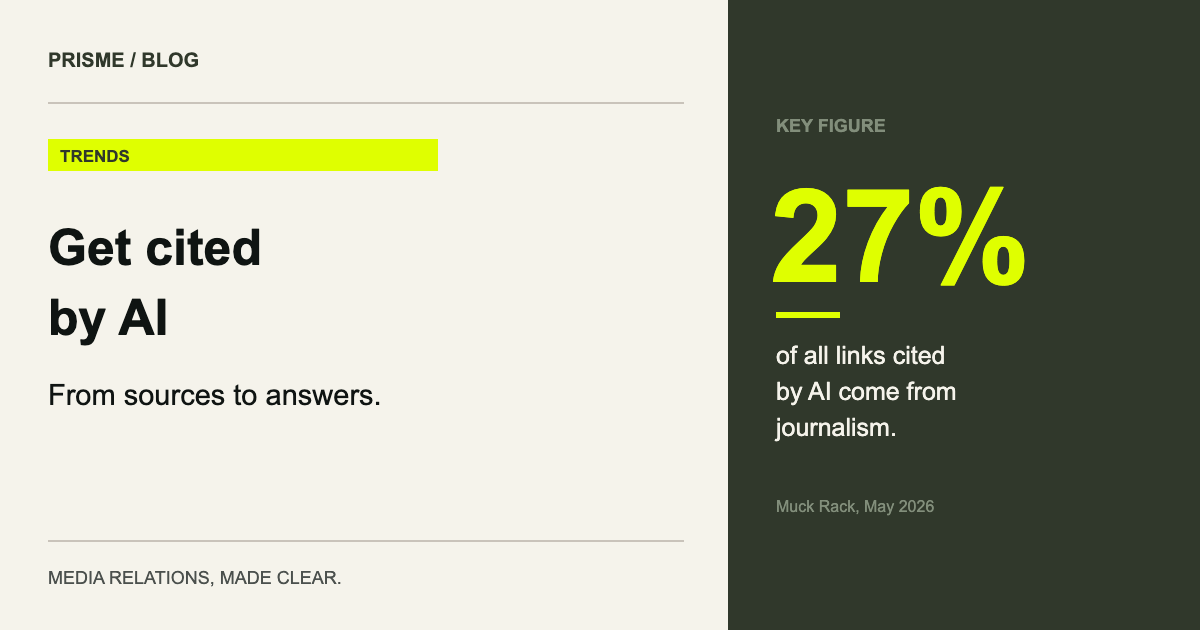
- Journalism remains stable at 27% of all links.
- Paid content: about 0.3%.
- Press releases are cited 3.5 times more in trend queries than in “best of” queries.

1. Recency counts, differently per AI. 56% of ChatGPT’s citations were published in the last 12 months, against 36% for Claude (July 2025 edition). For ChatGPT, recent coverage weighs more. For Claude, older reference articles still count.
2. There’s no universal “top 10” of media. Only 15% of top-cited sources appeared in the top 10 across several industries. Each sector has its own references, often trade and niche media, not only the big national titles.
3. Different AIs read different things. In finance, 90% of Claude’s top 10 sources were unique to Claude. Being visible in ChatGPT doesn’t guarantee being visible in Claude.
What this means: PR is now an AI visibility channel
For years, SEO meant optimizing your own website. With AI assistants, a big part of what’s said about you is built from what others write about you.
Paid ads don’t help much: they’re almost never cited. Your blog helps a bit. Being covered by the outlets AI assistants trust in your sector helps a lot.
The 5-step plan
Step 1: Audit what AI says about you today (1 hour)
Write down 10 questions your customers really ask. For example:
- “What’s the best [your category] for [your customer type]?”
- “[Your brand] vs [competitor]?”
- “How do I solve [problem you solve]?”
Ask each one in ChatGPT, Claude, Gemini and Perplexity. For each answer, note:
- Are you mentioned? Your competitors?
- Which sources are cited? List the outlets.
That list of cited outlets is gold: it’s your new priority media list.
Step 2: Target the media AI trusts in your sector
Compare your audit list with the outlets you usually pitch. Often you’ll find:
- Trade media you neglected because their audience is “small”.
- A few reference articles (comparisons, rankings, guides) that get cited again and again.
- Data sources (studies, barometers) the AI uses for facts.
Prioritize them. A mention in a trade publication your AI cites may now be worth more than a national article it ignores.
Step 3: Give journalists something citable
AI assistants cite facts, numbers and clear statements. So do journalists. The pitch elements journalists value most are relevance (70%), access to sources for interviews (58%) and original data (40%) (Muck Rack State of Journalism 2026).
The best AI-visibility asset you can create is original data: a survey, a barometer, an analysis of your product data. Journalists cover it, and the AI then cites the articles and your study.
Step 4: Be consistent and keep it fresh
- Pitch all year, not only at launches. ChatGPT favors recent coverage.
- Use the same facts everywhere: founding year, number of customers, what you do in one sentence. Contradictions confuse humans and machines.
- Publish your press releases on your own newsroom, with clear facts. Press releases are increasingly cited.
Step 5: Measure every quarter
Re-run your 10 questions every 3 months. Track:
- How often you’re mentioned, vs competitors.
- Which new sources appear.
- Which of your press coverage gets cited.
That’s your new PR KPI, next to the classic coverage report.
What doesn’t work
- Paying for sponsored articles to “feed the AI”: paid content is almost never cited.
- Mass-producing AI-written blog posts. They don’t build authority, and they’re not what assistants cite most.
- Spamming journalists with generic pitches: 88% delete pitches that miss their beat (Muck Rack 2026).
Doing it with PRisme
With PRisme, once your audit is done, describe your topic and find the journalists who cover it among 30,000+ verified French press contacts, with their latest articles. Write your press release, pitch, follow up and keep every exchange in a shared CRM, all in one place. Book a demo.
FAQ
Can I pay to be cited by ChatGPT?
No. There’s no official way to buy citations in AI answers, and paid content represents a tiny share of cited sources.
Is “GEO” (generative engine optimization) different from SEO?
Partly. SEO optimizes your own pages for Google. GEO is about being present in the sources AI assistants trust, which are mostly earned media. Good PR is a big part of GEO.
How long does it take?
Coverage can appear in ChatGPT’s answers quickly, since it favors recent content. Building a solid presence across assistants takes several months of consistent PR.
Sources
- Muck Rack — What Is AI Reading?, July 2025 edition (Unite.AI summary) and May 2026 edition (Muck Rack release)
- Muck Rack — State of Journalism 2026