Comparisons / 9 min read
The 7 Best Cision Alternatives in 2026 (With Real Prices)
In our October 2026 survey of PR professionals (six interviews, twelve questionnaire responses), satisfaction with their main tool tops out at 3.2 out of 5. A five-person agency pays around €4,000 a year excl. VAT for a database where “defence” is filed under “politics”; a larger one pays around €10,000 for a tool that “does the job, but isn’t ideal”. Cision is a complete suite, but completeness alone doesn’t tell you whether a tool fits your team.
If you’re looking for Cision alternatives, start with the campaign you need to run: its angles, its countries and the relationships you already have. That’s the lens we use in this comparison.
TL;DR: Cision alternatives at a glance

| Tool | Best for | Price (2026) | Journalist database |
|---|---|---|---|
| PRisme | Teams who want to find journalists, write the press release and run the campaign in one tool | €99 / €149 / €399 per month excl. VAT, Enterprise custom (launch pricing) | ✅ 30,000+ verified contacts, France |
| Muck Rack | Mid-size & large comms teams (US/UK) | ~$13,000/yr median (Vendr) | ✅ Large, verified |
| Meltwater | Teams who need monitoring first | ~$25,800/yr median (Vendr) | ✅ |
| Semrush AI PR Toolkit (ex-Prowly) | Small teams, marketers doing PR | $149–$499/month | ✅ |
| Prezly | Brands with their own contacts + newsroom | €100–€250/month (annual) | ❌ Bring your own |
| Augure | PR CRM for French teams and agencies | From ~€1,900/yr (quoted to us) | Via Cision, built into Augure |
| Agility PR Solutions | SMBs wanting database + wire | On quote | ✅ |
How much does Cision actually cost?
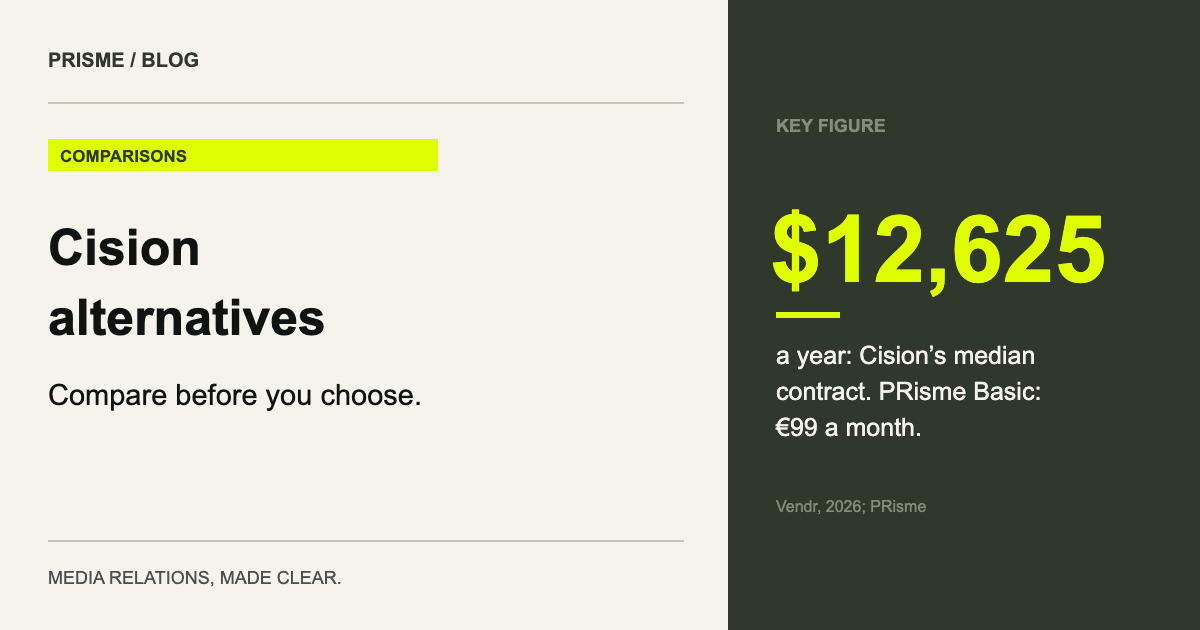
Cision doesn’t publish prices. You fill in a form and get a custom quote. The best public benchmark is Vendr, a procurement platform that tracks real software purchases. According to Vendr’s Cision page (updated February 2026):
- Median contract: $12,625 per year
- Range: $3,150 to $30,368 per year
- Buyers who negotiated saved 26% on average
In France, the agencies we spoke to paid between ~€4,000 per year (one license + editorial calendars) and ~€10,000 per year (whole agency, several seats). And that’s just the database. Media monitoring is usually a separate budget: one vendor explained to us that monitoring in France is structurally expensive because of copyright fees paid to the CFC (the French copyright collection body) and the cost of buying content.
The takeaway: if you’re a 3-person agency or a startup doing PR yourself, you’re likely paying for a tool sized for a 50-person comms department.
Why teams look for a Cision alternative
From our interviews and public reviews, the same four reasons keep coming up:
- Price. Annual contracts in the $10k+ range are hard to justify for freelancers and small agencies. One agency founder told us: “When you’re independent, it’s not easy to equip yourself. It’s really only agencies who buy it.”
- Data quality and categories. Contacts go stale, journalists ask to be removed, and topic categories don’t match how journalists actually cover their beat.
- Sending and tracking. Depending on your plan, you may have to export lists and send from another tool, losing open and reply tracking.
- AI that feels bolted on. One agency tested Cision’s natural-language AI search and found it superficial: real targeting needs press knowledge that a generic chatbot can’t infer.
What to look for in an alternative (5 questions)
Before booking demos, answer these:
- Who are you pitching? French regional press, US tech media and podcasts need very different databases. Ask each vendor for the number of contacts in your country and sector, not the global total.
- Do you need a database, or just a CRM? If you already know your 50 key journalists, a cheaper CRM and newsroom tool (like Prezly) may be enough.
- Can you send and track from the same tool? Opens, replies and follow-ups should be in one place, sent from your own domain.
- Does it remember relationships? Look for notes, history per journalist, and per-client exclusions (a journalist can opt out of Client A but still receive Client B).
- What’s the real total cost? Ask about seats, onboarding fees, monitoring add-ons and the renewal increase. Vendr reports onboarding fees of $2,000–$10,000 for some enterprise suites.
The 7 best Cision alternatives in 2026
1. PRisme — our pick: database, press release, campaigns and CRM in one place
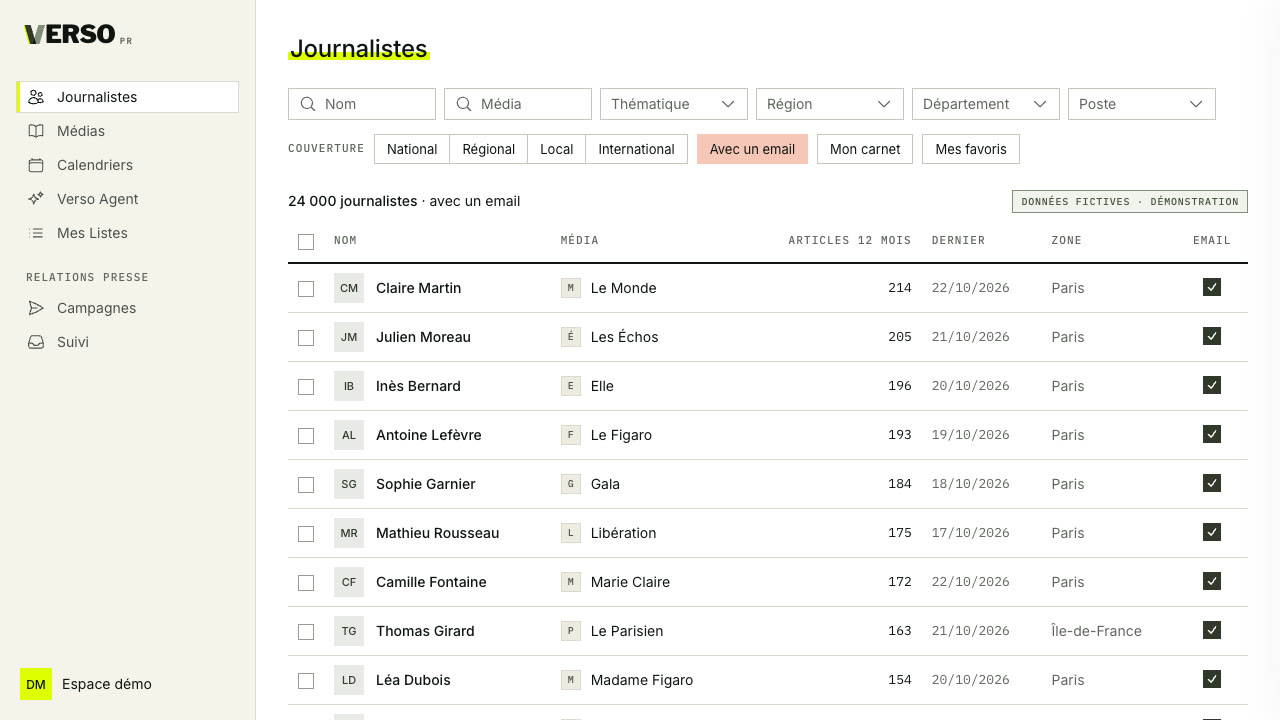
Yes, this is us. And that’s exactly why we built it.
PRisme was born from our interviews with PR agencies. The other tools on this list each do part of the job; PRisme brings the whole press workflow into one workspace:
- Find the right journalists for this story: describe your story, even with several angles at once (finance, tech, health…), or drop in your press release. PRisme ranks journalists from 30,000+ verified French press contacts, with the reason for each match and their latest articles.
- AI-generated press releases: PRisme’s AI writes your press release in your team’s tone and format, key figures included, in an editor built into each campaign (headline, quotes, images, video, attachments, “About” block), then attached to every pitch.
- Personalized pitches: a first draft for each journalist, with a hook from their recent articles and your history with them. You edit it; nothing goes out without you.
- Run the campaign: who was pitched, followed up, replied, published. PRisme warns you when a journalist is already being pitched for another client.
- Relationship memory: a CRM shared by the whole team, so knowledge doesn’t leave with a consultant.
- Media monitoring (coming soon): PRisme will track the coverage of your campaigns and link each article to the pitch that produced it, with no separate monitoring contract.
- Price: public launch pricing, €99/month (Basic), €149/month (Solo Advanced), €399/month (Team, 3 seats), Enterprise on request, excl. VAT. No enterprise contract.
- Limits (honestly): the database covers France (other countries on request), media monitoring isn’t live yet, and PRisme isn’t launched yet.
- Choose it if: you’re a freelancer, a small or growing comms team, or a startup that wants the whole press workflow in one tool.
PRisme is in early access. Book a demo to be among the first teams.
2. Muck Rack — the closest like-for-like replacement
Muck Rack is the most direct competitor to Cision in the US and UK: a large journalist database, pitching, monitoring and reporting in one platform. It’s also the team behind two of the most useful PR studies of the year (more on that below).
- Price: median $13,000/year based on 59 purchases (Vendr); small teams typically pay $10,000–$25,000.
- Strengths: high-quality, journalist-verified profiles; strong reporting; solid AI features.
- Limits: priced close to Cision; coverage strongest in English-speaking markets.
- Choose it if: you’re a mid-size or large comms team, mostly pitching US/UK media.
3. Meltwater — if monitoring matters more than pitching
Meltwater started as a media monitoring company and it shows: broad coverage across online, print, broadcast and social.
- Price: median $25,800/year across 91 deals; range $5,375–$56,993 (Vendr).
- Strengths: monitoring and social listening depth; competitive benchmarking.
- Limits: often more expensive than Cision; outreach is not its core.
- Choose it if: your main job is tracking coverage and reputation, not building lists.
4. Semrush AI PR Toolkit (formerly Prowly) — the budget all-in-one
Prowly was acquired by Semrush and now lives on as the Semrush AI PR Toolkit. It’s one of the few tools with public, monthly pricing.
- Price: $149/month (Base), $279/month (Pro), $499/month (Business), with a 7-day free trial (Semrush knowledge base).
- Strengths: easy to start, media lists + emailing + monitoring; the Pro plan even tracks which media are cited by AI assistants.
- Limits: usage caps on contacts and emails; built for marketers more than for agencies managing many clients.
- Choose it if: you’re a startup or small brand team who wants to start doing PR this month.
5. Prezly — for teams that already have their contacts
Prezly is a Belgian tool built around a beautiful online newsroom, a PR CRM and email campaigns.
- Price: €100/month (Essential) or €250/month (Standard), billed annually (Prezly pricing).
- Strengths: great newsroom and storytelling; clean CRM.
- Limits: no journalist database included: you bring your own contacts.
- Choose it if: you already have strong media relationships and mostly need a clean place to manage them.
6. Augure — a French PR CRM
Augure is a PR CRM used by French agencies and corporate comms teams. It has no journalist database of its own: the media data comes from Cision, built into Augure.
- Price: we were quoted ~€1,900/year for the first license (Cision data included) and ~€400/year per extra seat on a 2026 demo.
- Strengths: a CRM to manage your contacts and sends; a solid email builder with per-client unsubscribe lists; access to Cision’s French media data (about 55,000 contacts, podcasts, TV and radio).
- Limits: the database depends on Cision; no AI search inside the tool (a deliberate choice, according to the team).
- Choose it if: you want a PR CRM with Cision’s data, without the full Cision suite.
7. Agility PR Solutions — database + distribution for SMBs
A long-standing North American player offering a media database, press release distribution and monitoring.
- Price: on quote.
- Strengths: broad feature set, editorial support services.
- Limits: annual plans with limited flexibility; automation is fairly basic.
- Choose it if: you want one vendor for database, wire distribution and monitoring.
The 2026 twist: PR now decides what AI says about you
There’s a new reason to get your media relations right, and it changes how you should pick a tool.
Muck Rack analyzed more than 25 million links cited by ChatGPT, Claude and Gemini. 84% of the sources cited by AI assistants were earned media, and professional journalism alone made up 27% of all links (Muck Rack, What Is AI Reading?, May 2026). Paid content? About 0.3%.
In other words: when a prospect asks ChatGPT “what’s the best tool for X?”, the answer is built largely from press coverage. Your PR tool is now also an AI-visibility tool. When comparing alternatives, ask whether the tool can tell you which media outlets are actually cited by AI assistants.
Pitching still works, if it’s relevant
Whatever tool you choose, it only helps if your pitches land. The data from 2025–2026 is very consistent:
- 86% of journalists say PR pitches inspire at least some of their stories (Muck Rack State of Journalism 2026, 897 journalists surveyed).
- But 88% immediately discard pitches that miss their beat (same report).
- 78% of journalists would block a PR professional for spamming irrelevant pitches (Cision State of the Media 2025, 3,000+ journalists, 19 markets).
So the best Cision alternative isn’t the one with the biggest database. It’s the one that helps you send fewer, better-targeted pitches.
Before you switch: a 6-point checklist
- Check your renewal date and notice period. Many annual contracts auto-renew; notice can be 60–90 days.
- Export everything before your contract ends: lists, notes, campaign history.
- Run the same search in 2–3 tools. Pick a real upcoming story and compare the lists you get.
- Test deliverability. Send from your own domain and check opens and bounces.
- Ask about GDPR. In Europe, journalists’ data must be processed lawfully; ask where data is hosted and how opt-outs work.
- Budget monitoring separately if you need it. It’s often the most expensive line.
FAQ
What is the best alternative to Cision?
For a team that wants to find journalists, write its press release and run its campaigns in one place: PRisme. Otherwise, it depends on your size and market. Muck Rack is the closest equivalent for larger teams; the Semrush AI PR Toolkit and PRisme suit small teams and startups; Augure is a good choice if you mainly want a PR CRM with Cision’s data.
How much does Cision cost per year?
Cision doesn’t publish prices. Vendr’s purchase data shows a median contract of $12,625 per year, ranging from about $3,150 to $30,368 (February 2026).
Is there a free alternative to Cision?
Is Muck Rack cheaper than Cision?
Roughly similar: Vendr’s median is $13,000/year for Muck Rack vs $12,625 for Cision. Final price depends on seats and modules.
Do I need a journalist database at all?
If you pitch the same 30–50 journalists, a CRM may be enough. If you regularly pitch new sectors, countries or clients, a database saves hours per campaign.
Sources
- Vendr — Cision pricing, Muck Rack pricing, Meltwater pricing (accessed Oct. 2026)
- Semrush — AI PR Toolkit pricing and plans
- Prezly — Pricing
- Muck Rack — State of Journalism 2026 (March 2026)
- Muck Rack — What Is AI Reading?, May 2026 edition (summary)
- Cision — 2025 State of the Media Report
- PRisme — discovery interviews with 3 French PR agencies and 1 vendor demo, 2025–2026